By Kevin Duska | Rogue Snippets
February 9, 2026
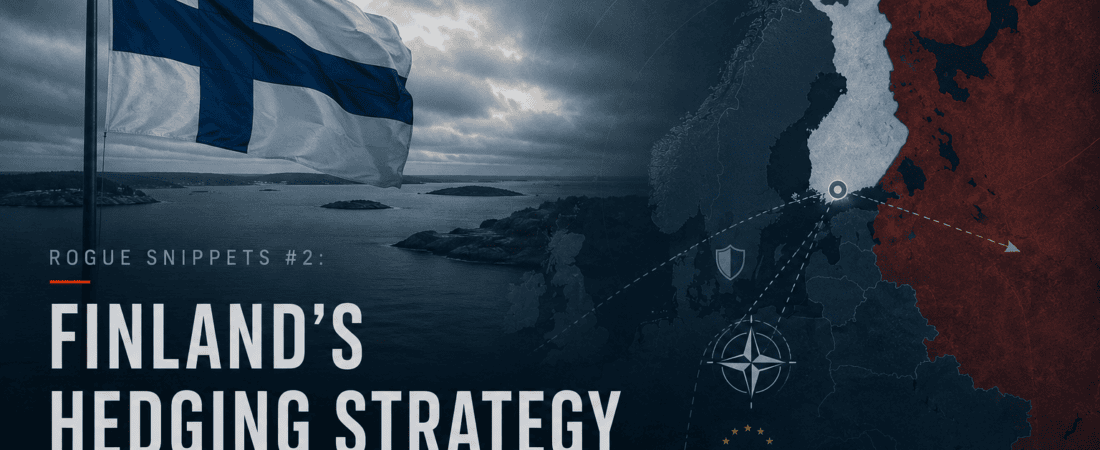
There’s a particular kind of clarity that comes from living next to an existential threat. Finland has 1,340 kilometers of border with Russia and exactly zero illusions about what miscalculation costs. When Helsinki joined NATO in April 2023, and abandoning eight decades of military non-alignment in doing so, the decision wasn’t driven by idealism about collective security. It was a cold calculation about survival in a deteriorating strategic environment – both relative to Finland’s geographical proximity to Russia and because of the ongoing systemic great power transition between the United States and China. .
Eighteen months later, that calculation looks prescient for reasons Finland didn’t anticipate. The threat from Russia remains significant, as it always has been, but something else has changed: the alliance Finland joined to escape uncertainty has become uncertain itself. Over the course of Donald Trump’s second term, the United States has again signaled that NATO commitments are conditional, that Article 5 guarantees are negotiable, and that European security is leverage rather than obligation. For large European powers, this is uncomfortable. For a middle power with no strategic depth and a thousand-mile frontier with a revisionist neighbor, it’s truly existential threat.
That said, Finland’s response hasn’t been panic. It’s been adaptation – and as you’ll notice below – Finland has a long tradition of adapting – to everything. And this pattern of Finnish adaptation, quiet, disciplined, and ruthlessly pragmatic, offers a model for every other small and middle power that finds itself inside an alliance framework it can no longer take for granted.
The Strategic Shift: When Guarantees Become Contingencies
The past year has accelerated a trend that began long before Trump’s return to the White House. European leaders have spent months acknowledging, with increasing candor, that American reliability can no longer be assumed. French President Emmanuel Macron has called for “strategic autonomy.” German Chancellor Olaf Scholz announced a €100 billion defense fund explicitly framed as preparation for a world where European security depends less on Washington. Poland is building the largest army in Europe. Even traditionally pacifist Sweden has abandoned neutrality and joined NATO—but with the same hedging mentality Finland demonstrates.
This isn’t alliance collapse. NATO still functions. U.S. forces remain stationed across Europe. The institutional architecture is intact. What’s eroding is something more fundamental: the belief that when crisis comes, alliance commitments will hold without hesitation. Deterrence doesn’t function on capability alone. It requires belief. And when political leaders openly condition their security guarantees, belief becomes harder to sustain.
For Finland, this shift arrived at an especially awkward moment. NATO membership was sold domestically as an anchor of predictability—a way to lock Finland into a stable security framework after Russia’s invasion of Ukraine shattered the European order. Instead, Helsinki now finds itself inside an alliance whose political center of gravity is wobbling. The institution meant to reduce risk has introduced a new category of risk: political volatility within the alliance itself.
Finland’s Answer: Preparation, Not Dependence
Faced with this dilemma, Finland has done something most middle powers haven’t yet internalized: it treats NATO membership as a force multiplier, not a replacement for national capacity. Alliance commitments are valuable. They’re also never assumed to be sufficient.
This posture has deep roots. Finland’s modern state formation was shaped by geography, vulnerability, and the necessity of strategic discipline. The country spent the Cold War navigating between Soviet pressure and Western alignment through a policy often called “Finlandization”—a term that carried pejorative weight in Western discourse but reflected sophisticated statecraft under constraint. Finland maintained armed neutrality, avoided formal alliances, and built a defense model premised on self-reliance: universal male conscription, territorial defense doctrine, massive ammunition stockpiles, and civil resilience programs that assumed external help might not arrive.
That mindset carried into the NATO era. Finland didn’t abandon total defense when it joined the alliance. It doubled down. Defense spending remains above 2% of GDP. Conscription continues, training 20,000 conscripts annually and maintaining a wartime mobilization strength of 280,000—one of the largest armies in Europe relative to population. Civil defense infrastructure includes 50,000 bomb shelters capable of housing the entire population. Ammunition reserves are calculated for prolonged high-intensity conflict without resupply. The Finnish Defence Forces are now accelerating indigenous AI development through partnerships with companies like NestAI, focusing on data-centric command and control systems, situational awareness, and autonomous capabilities The Defense PostPuolustusvoimat—capabilities that reduce dependency on external intelligence sharing during crisis.
This approach reflects a deliberate avoidance of what we might call “alliance dependency syndrome.” Rather than assuming NATO guarantees will always function smoothly, Finland plans for scenarios where they may be delayed, contested, or politically constrained. It’s not withdrawal from the alliance. It’s insurance against the alliance’s failure to function at the moment it’s needed most.
Culture as Strategy: Sisu and the Politics of Preparedness
You can’t understand Finland’s strategic posture without understanding sisu—a Finnish concept often translated as resilience or grit but more accurately understood as a cultural disposition toward endurance without expectation of rescue. It’s the willingness to persist when conditions are brutal, when help isn’t coming, and when survival depends entirely on your own capacity.
This isn’t romantic nationalism. It’s cultural realism forged through centuries of geopolitical exposure. Finland spent six hundred years under Swedish rule, another century under Russian imperial control, fought two brutal wars against the Soviet Union during World War II, and emerged from that experience with a collective understanding that survival is never guaranteed by others. That history has practical political consequences: public support for conscription remains strong, defense spending enjoys broad consensus, and civil preparedness is treated as a societal obligation rather than government overreach.
This cultural disposition gives Finland a distinct advantage in an era of alliance uncertainty. Where other middle powers still frame security as something outsourced to larger allies—where defense spending is politically unpopular and conscription unthinkable—Finland approaches security as a shared burden that begins at home. Alliance commitments supplement national capacity. They don’t replace it.
The fusion of culture and policy creates a feedback loop. Strategic realism reinforces cultural expectations of self-reliance, which in turn enables politicians to maintain defense investments that would be politically toxic elsewhere. It’s why Finland can spend heavily on defense during peacetime without domestic backlash. It’s why Helsinki can acknowledge American unreliability without triggering panic. The cultural assumption is that external guarantees were always contingent, so their erosion doesn’t shatter foundational beliefs about security.
The AI Dimension: Hedging Through Technology
There’s another layer to Finland’s hedging strategy that deserves attention: technological autonomy in artificial intelligence and autonomous systems. In 2025, the Finnish Defence Forces released a new data and AI strategy designed to guide the organization toward data-centric command and control, with plans to establish an FDF AI Centre of Excellence operational by 2026 Puolustusvoimat. This isn’t just procurement. It’s a deliberate effort to build indigenous AI capabilities rather than rely on allied systems.
The strategic logic is clear. Modern warfare increasingly depends on AI-enabled decision-making: battlefield management systems, autonomous drones, predictive logistics, electronic warfare, cyber operations. If Finland becomes dependent on U.S. or NATO AI architectures for these functions, it inherits new vulnerabilities. What happens if access to allied AI systems is delayed during crisis? What if political tensions lead to restricted technology sharing? What if adversaries target the data-sharing infrastructure that makes allied AI integration possible?
Finland’s partnership with NestAI focuses on intelligent unmanned systems and command-and-control technologies, emphasizing collaboration with indigenous defense industry rather than foreign dependency The Defense Post. The approach mirrors Finland’s broader defense philosophy: develop domestic capacity first, integrate with allies second. It’s hedging through technological sovereignty.
This matters beyond Finland. As AI becomes central to military operations, middle powers face a choice: become dependent on great-power AI architectures, or invest in indigenous capabilities that allow autonomous action if alliance integration fails. Finland is choosing the latter. It’s a model other middle powers should study closely—especially Canada, which has world-class AI research capacity but minimal defense AI investment.
What Canada Should Learn (And Won’t)
The contrast with Canada is instructive and depressing. Canada shares many structural similarities with Finland: a middle power with vast territory, limited population, proximity to a potentially hostile neighbor (though our threat assessment of the United States has shifted dramatically in ways unthinkable two years ago), and reliance on alliance frameworks for security. Both countries benefit enormously from collective defense. Neither can act independently as a great power.
But where Finland has built strategic autonomy as insurance, Canada has outsourced security so completely that we’ve lost the capacity for independent action. Our defense spending hovers around 1.3% of GDP—well below NATO’s 2% target and pathetic compared to Finland’s investments. We have no conscription, no civil defense infrastructure, and a military so hollowed out that procurement scandals are more frequent than operational deployments. We can’t defend our Arctic sovereignty, can’t patrol our maritime approaches, and can’t sustain expeditionary operations without American logistics support.
Even more damning: we lack the political culture to fix it. Where Finnish citizens accept defense spending and conscription as necessary, Canadians treat military investment as wasteful. Where Finland builds bomb shelters, we build condos. Where Helsinki plans for scenarios in which NATO help doesn’t arrive, Ottawa assumes American protection is permanent—even as Trump openly threatens annexation and treats Canadian sovereignty as negotiable.
The Alberta independence movement makes this pathology even starker. Alberta separatists have met three times with U.S. State Department officials seeking $500 billion in credit to fund independence. It’s dependency-seeking behavior masquerading as autonomy. They want to escape Canadian federalism by becoming American clients—exactly the opposite of strategic hedging. A truly independent Alberta would need Finnish-style total defense: conscription, civil resilience, ammunition stockpiles, indigenous AI capabilities, and the political will to sustain them. Instead, Alberta separatism is performative grievance politics with no serious plan for self-sufficiency.
Finland joined NATO seeking security but never assumed the alliance would provide it unconditionally. Canada joined NATO seventy-five years ago and forgot how to provide security for ourselves. That’s the difference between hedging and dependency.
The Broader Lesson: Resilience Beats Reassurance
Finland’s approach offers a clear lesson for other small and middle powers navigating alliance uncertainty. Countries like Canada, the Netherlands, Poland, and the Baltic states face a common vulnerability: they benefit enormously from collective defense but have limited capacity to act independently if political support from larger allies falters. Finland’s response shows that this dilemma need not produce paralysis.
The central lesson isn’t withdrawal from alliances. It’s preparation for ambiguity. Finland invests domestically before relying externally. It treats strategic autonomy as insurance rather than defiance. It avoids framing alliance loyalty as dependence. This posture allows Finland to remain a credible NATO partner while quietly reducing exposure to political shocks beyond its control.
There’s a counterargument worth addressing: Isn’t this an overreaction? NATO remains intact. U.S. forces are still deployed in Europe. Article 5 hasn’t been formally weakened. From this perspective, Finland’s hedging risks signaling mistrust where reassurance is needed, potentially undermining alliance cohesion through self-fulfilling skepticism.
But this argument misunderstands how deterrence functions. Security guarantees are effective only insofar as they’re believed. When political leaders openly condition commitments—when Trump suggests territorial concessions, when European leaders acknowledge American unreliability—belief erodes. For small states, waiting for clarity before preparing is not caution. It’s risk. Finland’s approach isn’t alarmist. It’s prudent. Preparing for uncertainty doesn’t undermine alliances; it strengthens them by ensuring that national security doesn’t hinge on assumptions about others’ behavior.
Conclusion: Finland as Bellwether, Not Outlier
Finland’s experience over the past eighteen months suggests that the real challenge facing small and middle powers isn’t alliance collapse. It’s alliance unpredictability. The institutional architecture may remain intact even as the political foundations become unstable. In that environment, the states best positioned to survive are those that combine alliance participation with domestic resilience and cultural realism.
Finland joined NATO seeking security. What it has demonstrated instead is how security must now be built: through self-reliance first, alliance support second, and ruthless honesty about what guarantees actually guarantee. That’s not cynicism. It’s survival.
For middle powers still operating under assumptions of alliance continuity—especially Canada—the Finnish model is uncomfortable. It requires political courage to tell citizens that security is their responsibility, not something outsourced to larger allies. It requires investment at levels that are politically unpopular. It requires cultural shifts toward preparedness and away from complacency.
But the alternative is worse: remaining dependent on guarantees that are eroding in real time, waiting for clarity that won’t come, and discovering during crisis that the alliance you joined to escape vulnerability has introduced new vulnerabilities of its own.
Finland understands this. The question is whether anyone else will figure it out before it’s too late.
Read more:
- The Finnish Model: Strategic Autonomy Inside Alliances — Comprehensive analysis of Finland’s total defense framework and what middle powers should learn
- Nordic Defense Cooperation and the New Security Architecture — How Finland, Sweden, and Norway are building regional resilience as insurance against alliance failure
- Finland’s AI-Enabled Defense: Data Sovereignty as Strategic Hedging — Technical deep dive on Finnish Defence Forces’ indigenous AI development and what it means for allied interoperability