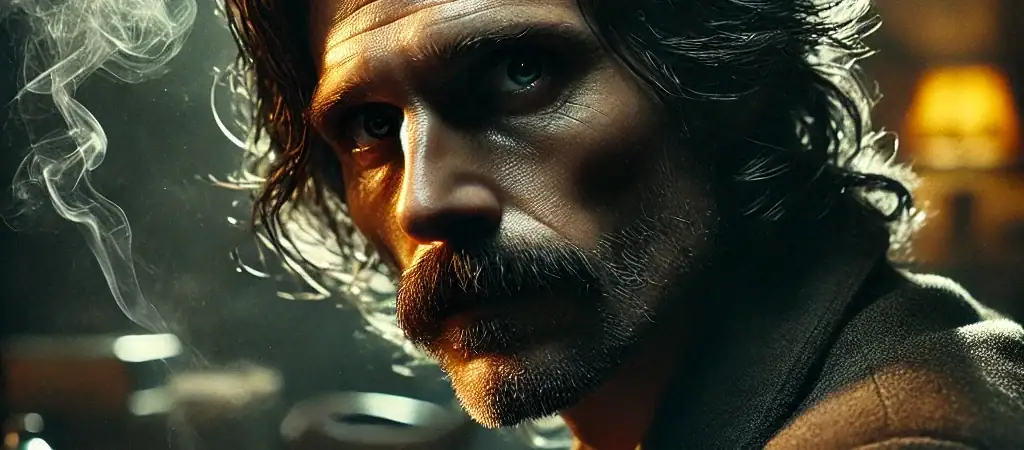
I. Introduction – The Gospel of Rust Cohle
N.B. This post most certainly contains spoilers about True Detective Season 1
🎵 “Impossible Germany” – Wilco)
I don’t know if it was the caffeine overdose, the algorithm deciding I needed another existential crisis, or just my own inability to sleep, but at 3 AM, I found myself watching True Detective Season 1 again.
Not just watching—absorbing it. Letting it unfold like an old book I had memorized but needed to revisit, just to make sure it still meant the same thing.
And it hit me.
Rust Cohle isn’t just a fictional character. He’s an inevitability.
I used to think of True Detective as a crime show with a heavy dose of philosophy, but that’s underselling it. It’s not just a story—it’s scripture for the terminally disillusioned. Rust Cohle isn’t a character so much as a philosophical archetype, the distilled essence of what happens when you stare too long at the mechanics of the world and come to a single, brutal conclusion:
It’s all bullshit.
And the worst part? He isn’t wrong.
There’s a moment in the show—somewhere between his slow, unfiltered monologues about time being a flat circle and his complete rejection of human consciousness as anything but an evolutionary mistake—where I stopped watching as a passive observer and started listening like I was at a lecture. Not because I wanted to. Because I couldn’t help it.
Rust Cohle thinks like I think.
Not in the exact same words. Not with the same scars.
But the structure of it—the detached, systems-level observation of human behavior, the exhaustion of trying to explain to people what they don’t want to see, the acknowledgment that we all just keep doing the same shit over and over, hoping for different results—that part felt uncomfortably familiar.
Then the episode ended, the screen went black, and I caught my own reflection.
And for a split second, I saw Rust Cohle staring back at me.
Which is hilarious.
Because while I might dress like him, I do not look like him.
Rust is wiry, sunken, and built like a man who survives off beer and nicotine.
I am built like a fridge. A broad-shouldered, solid block of a human being.
Rust looks like a ghost that hasn’t realized it’s dead yet.
I look like a guy who could move a fridge up a flight of stairs.
But the vibe? Yeah. That part stuck.
I mostly wear sweats, Carhartt, or old band t-shirts while running the Prime Rogue Empire (cough).
I have the perpetual dead-eyed stare of a man who’s spent too much time analyzing things that shouldn’t be analyzed.
And I’ve been told since seventh grade that I have “dead eyes”—except when I smile.
(Shoutout to my middle school French teacher, Mme Gauvin, who was so alarmed by my resting face that she suspected I was being abused. Nope, just my face. Thanks for the concern, though.)
So now I have to ask: What does it mean when you see yourself in a man who stares into the abyss and doesn’t blink?
I don’t drink Lone Star in barren rooms at dusk.
I don’t speak in cryptic parables about existence while chain-smoking.
But I do drink coffee into the small hours of the night, muttering to myself about systemic failures and inevitable collapse.
And yet, when Rust speaks, I find myself nodding.
Human consciousness is a tragic misstep in evolution.
Stability is a myth we tell ourselves to avoid screaming into the void.
Time does feel like a flat circle if you’ve seen the same cycles repeat often enough.
I know I’m not alone in this. Rust Cohle resonates with people not because he’s edgy or broken, but because he represents the part of us that understands the joke has always been on us.
But here’s the real question—the one that keeps me up at night long after the caffeine should’ve worn off: What happens if you stop fighting it?
Is that peace? Or just another step toward accepting that everything was meaningless all along?
Maybe it’s both.
Maybe it’s neither.
Either way, we need to talk about Rust Cohle.
II. The Philosophy of Rust – A User’s Guide to Fatalism
🎵 “Turtles All the Way Down” – Sturgill Simpson)
A. Time is a Flat Circle – The Worst Recurring Nightmare
Rust Cohle doesn’t just believe in fatalism—he’s trapped in it.
Most people think about time in a linear way. Cause, effect. One thing leading to another. Progress. Growth. Change. Hope.
Rust Cohle looks at that same sequence and sees the exact same mistakes happening again and again, on a loop, forever.
“Someone once told me time is a flat circle. Everything we’ve ever done or will do, we’re gonna do over and over and over again.”
At first glance, it sounds like some weird late-night dorm room philosophy—until you realize that Rust is paraphrasing Nietzsche without the frilly German prose.
Nietzsche called it “eternal recurrence”—the idea that if the universe is infinite but everything inside it is finite, then eventually, the same events will happen again, down to the smallest detail. You, reading this, have done it before. You, thinking “that’s ridiculous,” have rejected this idea before. And you will again. And again. Forever.
If that thought makes your stomach turn a little, congratulations—you now understand why Rust Cohle never looks happy.
Because once you accept that, everything becomes meaningless in a very specific way.
It’s not just that we’re doomed to repeat history in broad strokes.
It’s that we’re doomed to repeat ourselves, over and over.
Every small moment. Every choice we think is ours.
Every failure. Every war. Every heartbreak.
Every time you stub your toe on that same fucking table leg.
Again. Again. Again.
And once you see it, you can’t unsee it.
Most people don’t have the stomach to go all the way with this thought. But Rust? Rust took that thought to its logical conclusion, looked at the existential horror of it all, and just lit another cigarette.
B. “Human Consciousness is a Tragic Misstep in Evolution”
This is where Rust leaves Nietzsche behind and heads into even darker territory.
He’s not just saying that life is meaningless. That’s easy. That’s entry-level nihilism.
He’s saying that we never should have been here in the first place.
“I think the honorable thing for our species to do is deny our programming. Stop reproducing. Walk hand in hand into extinction. One last midnight, brothers and sisters, opting out of a raw deal.”
That’s next-level bleak.
Most existentialists at least hold out some hope that, even if life is meaningless, we can create meaning. Rust Cohle? He looks at human existence and sees a colossal mistake.
Our intelligence didn’t make us better—it just gave us the tools to understand how doomed we are.
Think about it.
No other species has to sit around wondering about the nature of its own suffering.
Dogs don’t worry about the inevitability of death.
Dolphins don’t have mid-life crises.
Birds don’t wake up one morning questioning whether they’re truly happy or if they’ve just convinced themselves they are because the alternative is too unbearable.
But humans? We get all of that, and we get to be aware of it.
We are the only species smart enough to understand that nothing lasts, that suffering is inevitable, and that everything we build will one day be dust.
That’s not a gift. That’s a cosmic joke.
And Rust? Rust is the only one not laughing.
C. The Greatest Tragedy? Rust is Right.
Rust Cohle is a hard character to disagree with because he’s not wrong.
He’s not some college freshman who just read Camus for the first time and wants to tell you about the absurd.
He’s not some drunk at the bar trying to convince you that life is a scam.
He’s a man who has thought through every possible justification for meaning and found them all lacking.
The worst part? He’s not even bitter about it.
There’s no rage. No theatrical despair.
Just a man who has accepted the horror of reality and keeps functioning anyway.
And that’s the part that sticks with me.
Most people who go down the “nothing matters” rabbit hole either retreat into distraction or spiral into despair.
Rust? He still does his job.
He still gets up every day, puts on that sweat-stained button-up, and investigates murders in a system he knows is corrupt and broken.
Not because he believes in justice.
Not because he thinks it will change anything.
But because what else is there to do?
And maybe that’s the real lesson Rust Cohle has to teach us.
Not that nothing matters.
Not that we’re all just walking toward inevitable extinction.
But that you keep going anyway.
BIII. How to Live Like Rust Cohle – A Practical Guide
🎵 “People as Places as People” – Modest Mouse)
There’s a moment in True Detective when Marty Hart, Rust’s less-philosophical but equally flawed partner, asks him if he ever wonders if he’s a bad man.
Rust, without missing a beat, replies:
“The world needs bad men. We keep the other bad men from the door.”
Now, I’m not saying you should fully embrace the Rust Cohle lifestyle—unless you want to alienate every single person you know and develop the aura of a man who has lived in his car by choice.
But if you find yourself drawn to his energy, there are a few things you can do to live like Rust Cohle—or at least, to better understand the mindset of a man who has seen too much and decided to keep going anyway.
Step 1: Develop an Intense and Possibly Unhealthy Relationship with Solitude
Rust isn’t just an introvert. He has fully transcended the need for human interaction outside of necessity.
If you want to channel that energy, you have to:
✅ Go on long, unnecessary drives at night with no destination. Bonus points if it’s in a vehicle that has seen better days.
✅ Stare into the middle distance whenever people are talking. Make them wonder if you’re listening or contemplating the heat death of the universe.
✅ Memorize enough existential philosophy to ruin dinner parties. Nietzsche, Schopenhauer, Camus—it doesn’t matter. The key is being able to explain why life is meaningless while holding eye contact with someone who just asked you to pass the mashed potatoes.
Caution: This step will make most people deeply uncomfortable around you. That’s how you know it’s working.
Step 2: Maintain a Look That Screams “Haunted by My Own Thoughts”
Rust Cohle looks like a man who has lost track of the last time he had a full night’s sleep.
He has stringy, unwashed hair, sunken eyes, and nicotine-stained fingers.
He wears the same sweat-stained button-up like a uniform.
Now, you don’t have to go full Rust—especially if you have a job that involves talking to humans who expect you to look functional.
But if you want to capture the essence, you can:
✅ Master the thousand-yard stare. Stare just past people, like you’re seeing something they aren’t.
✅ Invest in one really good, really worn-out shirt. Wear it until people start asking if you own other clothes.
✅ Look perpetually tired. Caffeine helps. So does thinking about how every civilization collapses eventually.
Caution: You don’t have to actually destroy your personal hygiene. The goal is “haunted but functional,” not “actively decomposing.”
Step 3: Become the Guy People Avoid Talking to at Work
Rust is brilliant, competent, and deeply unsettling to be around.
If you want to channel his workplace energy, follow these simple guidelines:
✅ Answer simple questions with deeply uncomfortable truths.
- Coworker: “Hey, how’s your weekend?”
- You: “Do you ever think about how society is just an elaborate game we all agree to play so we don’t collapse into chaos?”
- Coworker: “…Cool, man.”
✅ Refuse to engage in small talk. Ever. If someone tries to make polite conversation, just look at them like you’re deciding whether they’re worth the effort of speaking.
✅ Be the person who people say is “a genius, but…”
- “Yeah, they’re great at their job, but every time I talk to them, I leave with more existential dread than I had before.”
Caution: This will result in fewer invitations to office happy hours. That’s a feature, not a bug.
Step 4: Find a Nemesis Who Is Your Exact Opposite
Rust Cohle wouldn’t be Rust Cohle without Marty Hart.
Marty is chaotic but functional, emotionally repressed but charming.
Rust is rigid, controlled, and utterly incapable of pretending to be normal.
You, too, need a Marty Hart in your life.
✅ Find someone who believes in things like “the greater good” and “institutions can work.”
✅ Get into endless arguments where neither of you will ever change your mind.
✅ Respect them, but also constantly push their buttons.
Caution: This relationship must be rooted in mutual respect. If it turns into just insulting each other without any underlying camaraderie, you’ve crossed the line into “toxic asshole” territory.
Step 5: Have a Philosophy That Makes People Uncomfortable but is Logically Sound
Rust Cohle doesn’t just say things.
He backs them up with cold, ruthless logic.
If you want to truly embody his energy, you have to:
✅ Never believe something just because it’s comforting. If a belief doesn’t hold up under scrutiny, discard it.
✅ Be willing to argue your point relentlessly, even if it makes people uncomfortable.
✅ Think three steps ahead of everyone else.
Example:
- Person: “I think people are inherently good.”
- Rust Cohle Energy: “Then explain war, corruption, and why every civilization eventually collapses under its own weight.”
- Person: [visibly shaken]
Caution: You will not be fun at parties. That’s the point.
Step 6: Keep Functioning Anyway
This is the most important step—and the part that separates Rust from just another internet nihilist who listens to The Downward Spiral on repeat.
Because what else is there?
If you really want to embody Rust’s philosophy, you can’t just complain about how nothing matters.
You keep going anyway.
✅ Show up. Even when you don’t see the point.
✅ Do the work. Even when it feels futile.
✅ Solve problems, even when you know they’ll just be replaced by more problems later.
Because that’s what separates people like Rust from people who just want to be edgy.
Rust isn’t a nihilist.
He’s a man who understands nihilism fully, but instead of sinking into despair, he keeps moving forward.
And maybe, just maybe, that’s the real lesson here.
Not that nothing matters.
Not that the world is beyond saving.
But that you keep going anyway.
Because what else is there?
IV. The Paradox of Rust – Nihilism That Still Cares
🎵 “Farewell Transmission” – Songs: Ohia“)
There’s a fundamental contradiction at the core of Rust Cohle.
He believes in nothing.
And yet, he still acts like things matter.
This isn’t your standard, half-assed nihilism—the kind that fuels teenagers who think reading The Stranger once makes them deep.
Rust’s nihilism isn’t a rebellion.
It’s not an aesthetic.
It’s a conclusion.
He has looked at the world—its cycles of violence, its failures, its illusions of progress—and determined, with absolute certainty, that everything is ultimately pointless.
But he still wakes up and does the work.
He still chases murderers.
He still fights for justice in a system he knows is corrupt.
He still cares.
And that’s the part of Rust Cohle that’s hardest to explain.
A. The Nihilist Who Still Wakes Up for Work
Most people who arrive at nihilism do one of two things:
- They embrace total apathy. (Nothing matters, so why try?)
- They try to invent meaning where there is none. (Nothing matters, but I choose to pretend it does anyway!)
Rust does neither.
He accepts that nothing matters—but he still functions inside that reality.
Why?
Because what else is there?
If you ask him, he won’t give you some poetic answer about finding purpose in the work.
He won’t tell you it’s about honor or duty or some deep-rooted personal belief in doing the right thing.
No. Rust works because the alternative is doing nothing.
And doing nothing?
That’s not an option.
Maybe it’s just inertia.
Maybe it’s a sense of obligation to the one part of himself that still remembers how to give a damn.
Or maybe—just maybe—some part of him still wants the world to make sense.
B. The Real Contradiction – He Doesn’t Actually Want the World to Burn
There’s a tendency to see Rust as a self-destructive force.
A man who has given up on life, dragging himself through existence out of sheer habit.
But that’s not quite right.
Rust doesn’t want the world to burn.
He just doesn’t trust it to do anything else.
If he were truly nihilistic in the way people assume, he wouldn’t bother investigating murders.
He wouldn’t bother arguing with Marty.
He wouldn’t even bother staying alive.
But he does.
Because somewhere, deep down, he still cares.
Even if he won’t admit it.
Even if he doesn’t believe in the things other people believe in—law, justice, redemption—he still wants to see some kind of resolution.
He still wants to put the bad guys away.
He still wants to know the truth.
He still believes in right and wrong, even if he won’t say it outright.
That’s the paradox of Rust Cohle.
He is a man who doesn’t believe in anything.
But he still acts like things matter.
And maybe—just maybe—he’s right.
C. Maybe the Real Lesson Isn’t That Nothing Matters—It’s That You Keep Going Anyway
This is where True Detective Season 1 pulls its best trick.
It lures you into Rust’s philosophy.
It makes you see the world the way he does.
It makes you nod along to his arguments.
And then, in the final episode, it does something Rust himself never saw coming.
It gives him hope.
When he looks up at the sky, after everything—after the case, after the years of self-imposed exile, after almost dying—he sees the stars.
And for the first time in the entire show, he doesn’t sound like a man resigned to the void.
He tells Marty:
“Once there was only dark. If you ask me, the light’s winning.”
It’s a quiet moment. A small shift. But it matters.
Because it’s Rust’s admission that maybe—just maybe—things aren’t as hopeless as he thought.
He’s not saying everything is good.
He’s not saying everything matters.
But he is acknowledging that maybe he doesn’t have the whole picture.
And maybe that’s the real takeaway from Rust Cohle.
Not that nothing matters.
Not that we should give up.
But that even if you believe in nothing, you still keep going.
Because what else is there?
Maybe the light is winning.
Or maybe that’s just what we tell ourselves.
Either way, the sun rises.
And Rust Cohle will be there to meet it.
V. The Gospel According to Rust – Key Life Lessons
🎵 “Elephant” – Jason Isbell) – such a great tune – still annoyed about that chick who thought it was about her instead of cancer.
Rust Cohle might be a deeply broken man, but let’s be honest—he’s not wrong about most things.
He doesn’t sugarcoat reality. He doesn’t pretend things are fine when they’re not. He doesn’t waste time on bullshit rituals of optimism that only exist to keep people comfortable.
And yet, despite his fatalism, he functions.
More than that—he thrives in his own way.
He’s one of the best detectives in the department. He outthinks nearly everyone around him. And despite being deeply unpleasant to work with, he still commands respect—not because people like him, but because they know he’s usually right.
So if we strip away the chain-smoking, the sweat-stained shirts, and the metaphysical exhaustion, what’s left?
A philosophy of life that actually makes sense.
So here they are: Rust Cohle’s key lessons for existence, as applied to the modern world.
A. People Are Mostly Full of Shit, and That’s Okay
Rust Cohle understands a fundamental truth that most people don’t want to admit:
Most people don’t actually care about truth. They care about comfort.
They don’t want to see things as they are—they want to see things as they wish they were.
And if you try to rip that illusion away?
They’ll either ignore you or hate you for it.
Rust doesn’t take this personally.
He doesn’t waste time trying to make people see what they refuse to see.
He just states the truth and lets people react however they’re going to react.
✅ Some people will agree with you.
✅ Some people will argue with you.
✅ Most people won’t even hear you, because they’re too caught up in their own narratives.
And that’s fine.
Because none of it changes the truth.
B. If You Don’t Drink Coffee Alone in a Barren Room at Least Once in Your Life, Are You Even Living?
There’s a certain honesty in drinking coffee alone at night while contemplating your existence.
No distractions. No conversation. Just you and the weight of everything you pretend not to think about during the day.
Rust Cohle understands that solitude isn’t loneliness—it’s clarity.
Most people fill their lives with noise because they don’t want to sit with their own thoughts.
Rust? He doesn’t run from it.
He welcomes it.
So if you ever find yourself sitting alone at 2 AM, staring into the middle distance over a rapidly cooling cup of coffee, wondering if you’ve ever actually made a choice that wasn’t dictated by prior circumstances—
Congratulations. You’re living authentically.
C. Sometimes, the Only Correct Response to Reality is Staring Off Into the Distance and Mumbling, “Yeah.”
Rust has a signature move.
When someone says something especially naïve, optimistic, or just downright stupid, he doesn’t argue.
He doesn’t correct them.
He just stares at them for a second, sighs, and mutters, “Yeah.”
And honestly? That’s the only appropriate reaction to most of what people say.
✅ “Things will work out.” → Yeah.
✅ “I just think the government has our best interests at heart.” → Yeah.
✅ “Love is the answer.” → Yeah.
Rust doesn’t waste energy debating things that don’t need to be debated.
He knows what he knows.
He understands how things actually work.
And if people don’t see it?
Not his problem.
Sometimes, the best thing you can do is just nod, sip your coffee, and keep moving.
D. A Good Mustache Can Get You Through Anything
This one speaks for itself.
Rust Cohle’s mustache isn’t just facial hair.
It’s a shield. A warning. A declaration of war.
The mustache is the physical manifestation of Rust’s entire worldview.
It says:
✅ “I don’t care what you think of me.”
✅ “I have seen things that would make you reconsider your entire life.”
✅ “I have no interest in explaining myself, but I will, just to make you uncomfortable.”
If you can’t grow one, that’s fine.
The mustache is a state of mind.
E. If You’re Going to Be an Outcast, Be the Best at What You Do
Here’s the truth about Rust Cohle:
If he wasn’t good at his job, he wouldn’t have been tolerated for a single second.
The only reason people put up with his nihilistic monologues, his refusal to play nice, and his general unwillingness to be a normal person is because he delivers results.
✅ He sees what others miss.
✅ He connects dots no one else connects.
✅ He gets shit done, even when no one wants to hear how he got there.
And this is the key takeaway:
If you’re going to be the kind of person who doesn’t fit in, make yourself indispensable.
Because when you’re the best at what you do, people will tolerate the fact that you don’t play by their rules.
And when they don’t?
Rust has the perfect response:
“Yeah.”
F. Keep Functioning, Even When Nothing Makes Sense
At the end of the day, Rust Cohle isn’t a nihilist.
Not really.
He believes in nothing, but he still acts like things matter.
He still gets up every morning.
He still works cases.
He still tries to solve problems in a world he knows is unsolvable.
Not because he thinks it will change anything.
Not because he’s clinging to some false hope.
But because what else is there?
That’s the real lesson of Rust Cohle.
Not that nothing matters.
Not that life is a pointless loop of suffering.
But that you keep going anyway.
Because when the credits roll, when the case is closed, when the existential dread has settled and all you’re left with is the quiet hum of your own thoughts—
The only real question left is:
“What now?”
And if the answer is “Keep moving,”
Then maybe, just maybe, that’s enough.
VI. Conclusion – So, What Now?
🎵 “Living Well Is the Best Revenge” – R.E.M.)
If you’ve made it this far, congratulations—you might be just as irreparably ruined as I am.
Or maybe you just appreciate a well-structured argument for existential dread.
Either way, here we are.
We’ve spent the last few thousand words dissecting why Rust Cohle resonates, why his philosophy makes an uncomfortable amount of sense, and why, despite his relentless fatalism, he still keeps going.
So the real question is:
What do we do with this?
Because it’s one thing to nod along to Rust’s monologues and think, Yeah, he’s got a point.
It’s another to actually apply any of it to your life without turning into a full-blown societal liability.
So let’s break it down.
1. Is Being Like Rust Cohle a Good Idea?
Absolutely not.
Unless you want to alienate everyone you know, develop a permanent thousand-yard stare, and become the person that HR “wants to have a word with” at least once a quarter.
Rust’s lifestyle is not aspirational.
He drinks like a man trying to forget things no one else even knows.
He talks like someone who hasn’t had a pleasant conversation in fifteen years.
He operates on the very edge of functional self-destruction.
This is not the roadmap to a well-balanced existence.
2. But Is He Wrong?
Also no.
Rust’s entire worldview is built on cold, hard logic.
He doesn’t sugarcoat things. He doesn’t play along with comforting illusions.
And that’s what makes him so compelling.
The real paradox of Rust Cohle is that he’s a nihilist who still functions.
Because he understands something most people don’t:
✅ Just because nothing matters doesn’t mean you stop moving.
✅ Just because the system is broken doesn’t mean you stop working.
✅ Just because people don’t want to hear the truth doesn’t mean you stop telling it.
That’s the real lesson.
Not that everything is doomed.
Not that hope is a joke.
But that you keep going anyway.
Because what else is there?
3. So, What’s the Takeaway?
If you’re looking for some kind of grand, uplifting conclusion, you’re in the wrong place.
Rust Cohle wouldn’t give you that.
And I’m not going to either.
Because life doesn’t wrap itself up in neat little bows.
And maybe, just maybe, that’s enough.
Because at the end of it all, when everything else is stripped away, Rust Cohle is proof that you can understand the joke and still get up in the morning.
And if that’s not a philosophy worth considering,
Then I don’t know what is.
Kevin Duska. Calgary, AB March 3, 2025